

Outdoor Play Benefits for Early Childhood Brain Development | Collaborative for Children
×
User Search
Give
Give Newsletter Signup
6/24/2026

How Outdoor Play Supports Brain Development in Young Children

Articles Media

In Greater Houston and across the country, families are asking an important question: what actually helps young children learn and grow? The answer is often simpler than it seems. Time outside, especially through unstructured play, is one of the most powerful ways to support early childhood brain development.

At Collaborative for Children, we see this every day in our work with families and our network of high-quality early learning providers. Outdoor play is not a break from learning. It is learning in one of its most natural and effective forms.
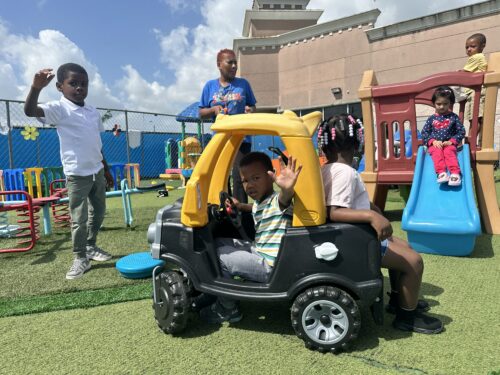
Outdoor Play Builds Stronger Brains Through Real Experiences

Children learn best when they can explore, test ideas, and interact with the world around them. Outdoor environments offer something indoor spaces often cannot. They provide open-ended, hands-on experiences that support how young brains grow.

Research consistently shows that play supports cognitive, social, and emotional development. Through play, children solve problems, think creatively, and build confidence in their abilities. When that play happens outdoors, the benefits expand. The variety of sights, sounds, textures, and movement creates a rich learning environment that strengthens neural connections.

The American Academy of Pediatrics also emphasizes that play builds executive function skills, which include memory, focus, and self-control. These are the core skills children need to succeed in school and life.

In simple terms, when children climb, dig, build, or imagine outside, they are strengthening the parts of the brain responsible for thinking, planning, and learning.

Outdoor Play Improves Focus, Attention, and Learning Readiness

Many parents notice that children come back from playing outside calmer and more focused. There is strong science behind that observation.

Outdoor play has been linked to improved attention spans, better classroom behavior, and stronger academic performance. Natural environments help reset the brain by reducing overstimulation and allowing children to recharge their ability to concentrate.

According to UNICEF, children who spend more time outdoors often show improved concentration and school readiness, along with stronger social skills. These early gains matter. Children who develop focus and regulation skills early are more prepared to succeed in kindergarten and beyond.

At Collaborative for Children, we work with early learning programs that intentionally design outdoor spaces to support this type of growth. Our Centers of Excellence incorporate structured and unstructured outdoor learning that aligns with research on child development and school readiness.

How Outdoor Activities Enhance Childhood Development

Outdoor Play Encourages Problem Solving and Critical Thinking

Unlike many indoor activities, outdoor play is often unstructured. There are no scripts, no step-by-step instructions, and no single right answer.

That is exactly why it is so powerful.

When children figure out how to climb a structure, build a fort, or create a game with friends, they are practicing problem-solving in real time. They learn through trial and error. They adapt. They think creatively.

Outdoor play supports flexible thinking and cognitive functioning by allowing children to explore new situations and solve problems independently.

This type of learning mirrors what educators call play-based learning. It is the same approach used in high-quality early childhood education programs, including those supported by Collaborative for Children. It is also a key difference between research-based learning environments and traditional drop-in daycare models that may not prioritize developmental outcomes.

Outdoor Play Supports Social and Emotional Development

Learning is not just about academics. It is also about relationships, communication, and emotional growth.

Outdoor play naturally creates opportunities for children to work together. They share ideas, negotiate rules, and learn how to manage conflict. These are essential life skills that cannot be taught through worksheets or screens.

Research shows that outdoor play promotes prosocial behavior such as cooperation, empathy, and communication. It also helps reduce stress and improves overall mood, which supports mental health from an early age.

One Houston-area early learning provider in our network shared this observation:

“After we expanded our outdoor learning time, we saw fewer behavior challenges and more collaboration. They were learning how to work together.”

This is the kind of transformation high-quality early childhood education can deliver when it is grounded in research and implemented intentionally.

Preparing Your Houston Backyard for a Summer of Learning, Play, and Connection

What Quality Outdoor Learning Looks Like in Early Childhood Education

Not all outdoor play is the same. Quality matters.

In Collaborative for Children Centers of Excellence, outdoor learning is part of a broader, research-based curriculum that blends STEAM learning with hands-on exploration. Educators are trained to guide learning without taking over the experience. They ask questions, introduce new vocabulary, and help children reflect on what they are doing.

For example, a simple activity like playing in a water table becomes a lesson in science and math. Children explore concepts like volume, measurement, and cause and effect. At the same time, they build language skills by describing what they see and do.

How Parents in Houston Can Support Outdoor Learning at Home

You do not need a large backyard or special equipment to support your child’s development through outdoor play.

Start with small, consistent moments:

  • Take a daily walk and talk about what you see
  • Let your child explore natural materials like sticks, leaves, and rocks
  • Encourage imaginative play outside, even if it is just pretending on a porch or patio
  • Limit screen time to make space for active play

The key is to give children time and freedom to explore. Even short periods of outdoor play can have a meaningful impact on development.

Why Outdoor Play Matters More Than Ever

Children today spend less time outdoors than previous generations. Increased screen time and busy schedules have changed how childhood looks.

At the same time, research continues to confirm what early childhood experts have known for years. Outdoor play is essential for healthy development across every domain, including cognitive, physical, social, and emotional growth.

For communities like Houston, investing in high-quality early care and education means creating environments where children can learn through movement, exploration, and play.

That is the standard Collaborative for Children is working to advance every day.

Play Builds Brains

FAQs

How does outdoor play improve brain development in young children?

Outdoor play improves brain development by strengthening cognitive skills like memory, attention, and problem solving. It also supports executive function, which helps children focus, regulate emotions, and learn effectively.

How much outdoor play do children need each day?

Young children should have several hours of physical activity each day, much of which can happen outdoors. Even 1 to 2 hours of outdoor play can significantly support health, learning, and development.

What makes outdoor play different from indoor play?

Outdoor play offers more space, natural elements, and open-ended experiences that promote creativity and exploration. It provides sensory-rich environments that are harder to replicate indoors, which enhances learning and development.

Related News