How to Raise Thankful Kids at Thanksgiving and All Year
×
User Search
Give
Give Newsletter Signup
11/9/2026

Raising Thankful Kids Takes More Than Saying “Thank You”

Articles Media

Thanksgiving gives families a natural reason to pause and name what they appreciate. Around tables across Greater Houston, children may share that they are thankful for their parents, grandparents, pets, teachers, favorite foods, or a much-loved toy. Those moments matter, but gratitude should not disappear when the leftovers are gone.

Raising a thankful child is not about forcing a polite response after every gift. It is about helping children notice the people who care for them, understand the thought behind kind actions, and learn how to express appreciation in meaningful ways. Researchers who study gratitude in children describe it as something deeper than good manners. It includes what children notice, how they think and feel about what they receive, and what they do to show appreciation.

At Collaborative for Children, we believe gratitude grows through the same process as many other early childhood skills: children watch, practice, receive guidance, and try again. Parents and educators can help by weaving gratitude into conversations, play, household routines, and relationships throughout the year.
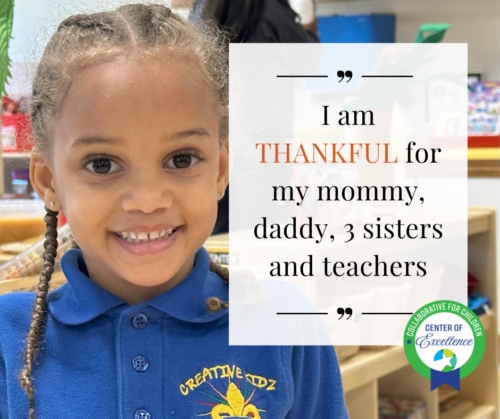
Parents Model Gratitude Through Everyday Actions

Children pay close attention to how adults speak and behave. If they regularly hear a parent thank a child care teacher, compliment someone who prepared dinner, or express appreciation for a beautiful morning, they begin to understand what gratitude looks and sounds like. Telling children to be thankful has value, but showing them gratitude in action gives the lesson meaning.

That modeling can be simple. You might say, “I’m thankful you helped put the toys away because it gave us more time to read together.” You could also point out someone else’s contribution by saying, “Grandpa spent time fixing your bike because he cares about you.” These statements help children connect a kind act with the person, effort, and intention behind it.

Research supports this everyday approach. One study of 101 parent-child pairs found that parents who engaged more often in gratitude-focused interactions also reported more frequent expressions of gratitude from their children. The study identified an association, not proof that one behavior directly caused the other, but it supports the value of making appreciation visible and talking about it regularly.

Children also need to hear adults thank them. A sincere “Thank you for helping your little brother” or “I appreciate how carefully you carried those plates” helps children see that their actions affect others. It turns gratitude into a shared family practice instead of a rule that only children must follow.

Families Teach Gratitude by Moving Beyond Good Manners

“Say thank you” is probably one of the most familiar reminders in parenting. Teaching children to respond politely is useful, but a child can say the words without fully understanding what they mean. True gratitude begins when children notice what someone did, think about why it mattered, and connect that action to a feeling of appreciation.

The Making Caring Common project at Harvard encourages adults to help children notice who or what they appreciate and think about why they feel grateful. Adults can ask children what another person did, what effort may have been involved, and how that kindness made the child feel.

For example, imagine that your child receives a handmade item from a relative. Instead of stopping at “What do you say?” you might ask, “What do you think Grandma had to do to make this for you?” A young child may notice that she chose the colors, spent time making it, and remembered what the child likes. That conversation helps move the focus from the object to the care behind it.

Parents should keep expectations appropriate for the child’s age. A preschooler may not express gratitude with the same depth or consistency as an older child, and a quiet or distracted response does not automatically mean the child is ungrateful. Gratitude develops over time, so the goal is steady practice rather than a perfect performance.

Family Routines Make Gratitude Easier to Practice

Thanksgiving traditions can introduce gratitude, but ordinary routines help it take root. A family does not need a complicated activity or a special lesson plan. A brief conversation at dinner, during the ride home, or before bedtime can help children build the habit of noticing good things and caring people.

Try asking one specific question instead of the broad “What are you thankful for?” You might ask, “Who helped you today?” or “What happened today that made you smile?” Other helpful prompts include, “What is something your teacher did for you?” and “What is one thing you enjoyed doing with someone else?” Specific questions are often easier for young children to answer because they give them a clear moment or relationship to consider.

Families can also create a gratitude jar. Children can draw pictures or ask an adult to write down something they appreciate. At the end of the week or month, the family can read the notes together. A young child who cannot yet write might draw a teacher, a friend, a pet, or a favorite family activity.

The activity itself is not the most important part. What matters is the conversation it creates. When adults ask follow-up questions and listen with interest, children learn that appreciation deserves attention.

4 Simple Ways to Raise an Emotionally Intelligent Child

Children Practice Gratitude Through Helping and Giving

Children understand ideas more deeply when they have a chance to act on them. Helping set the table, choosing a toy to donate, drawing a picture for a neighbor, or making a card for a teacher can connect gratitude with responsibility and care for others. These activities work best when children participate willingly and understand whom they are helping.

Parents should avoid using another person’s hardship to shame a child into appreciation. Statements such as “Other children have less, so you should be grateful” may create guilt without teaching genuine gratitude. A more constructive approach is to talk about a person’s needs, ask how the child might help, and let the child take part in an age-appropriate action.

A family service activity can also help children see themselves as capable contributors. A preschooler can place canned food in a donation box, help gather pet supplies for an animal shelter, or decorate cards for community helpers. Afterward, parents can ask what the child noticed, how helping may have made another person feel, and how the experience made the child feel.

These experiences connect gratitude with empathy. Children begin to understand that families and communities are made stronger when people notice one another, offer help, and appreciate the effort around them.

Responsibilities Help Children Appreciate Everyday Work

Young children benefit from having meaningful responsibilities at home. A simple chore helps a child learn that keeping a household running takes time and shared effort. It also gives parents an opportunity to notice the child’s contribution and show appreciation for it.

Toddlers can place napkins on the table, carry clothes to a hamper, or put toys into a basket. Preschool-aged children can help sort laundry, water plants, feed a pet with supervision, or clear safe items from the table. The task should be manageable, predictable, and appropriate for the child’s development.

Responsibilities should not be framed as punishment. Instead, parents can explain that every family member helps care for the home and for one another. When children participate in that work, they may begin to understand why another person’s contribution deserves thanks.

This also creates a natural exchange of gratitude. A parent can say, “Thank you for feeding the dog. That was an important job, and you remembered to do it.” The child experiences what it feels like to have an effort noticed, which can make it easier to notice the efforts of others.

Play-Based Learning Builds Empathy and Appreciation

Gratitude is closely connected to a child’s developing ability to understand other perspectives. During pretend play, storytelling, group projects, and hands-on STEAM activities, children encounter different ideas and learn that other people may think or feel differently. Those experiences create natural openings for conversations about empathy, cooperation, and appreciation.

Imagine several children working together to build a block tower. One child gathers pieces, another develops a plan, and another helps rebuild after the structure falls. A skilled early childhood educator can make those contributions visible by saying, “You thanked your friend for finding the long blocks. How did that help your team?” The children are learning about design and problem-solving, but they are also learning how individual efforts support a shared goal.

This is one reason our Centers of Excellence are designed as early learning environments, not simply drop-in daycare facilities. Trained educators use developmentally appropriate curriculum, hands-on play, STEAM exploration, and purposeful interactions to support the whole child. Children practice communication, cooperation, emotional regulation, and responsibility while they build early academic skills.

At Collaborative for Children, our perspective is simple: gratitude grows when children feel valued, participate in caring relationships, and have meaningful opportunities to value others. It cannot be taught through one holiday worksheet. It develops through the culture children experience at home and in high-quality early learning environments.

Parents Can Handle Ungrateful Moments Without Shame

Even children who are learning gratitude will sometimes complain about a gift, demand something they want, or forget to say thank you. That does not mean the lesson has failed. Young children are still learning impulse control, perspective-taking, and how to respond in social situations.

When an awkward moment happens, correct it calmly. If a child says, “I don’t like this present,” a parent might respond privately, “You do not have to like every gift, but we still speak kindly because someone thought about you.” Later, the parent can help the child identify one part of the gesture they can appreciate, such as the giver’s time or effort.

Parents can also prepare children before birthdays and holidays. Explain that they may receive something unexpected and practice a respectful response such as, “Thank you for thinking of me.” Role-playing gives young children language they can use when excitement, disappointment, or embarrassment makes it difficult to respond.

The goal is not to force children to hide every feeling. It is to teach them that feelings and behavior are different. A child can feel disappointed while still responding with kindness and respect.

Neuroscience-Based Parenting Tips Help Children Regulate Emotions

Houston Families Can Make Gratitude a Year-Round Habit

Thanksgiving is a useful starting point because gratitude is already part of the conversation. However, the most meaningful lessons come from what families repeat after the holiday. A weekly gratitude ritual, a regular family responsibility, or a habit of thanking people specifically can have more influence than one big seasonal activity.

Families in Greater Houston can also connect gratitude to their neighborhoods. Thank a crossing guard, make a card for a child care teacher, help a neighbor, or recognize a family member who handles an often-overlooked task. Children begin to see that care is happening all around them.

Gratitude should also leave room for difficult emotions. Children do not need to pretend everything is wonderful in order to appreciate something good. A child can feel sad about missing a family member and still be thankful for a phone call. They can feel frustrated by a difficult day and still recognize that a teacher helped them.

That balance makes gratitude honest. We are not teaching children to ignore hardship. We are helping them notice the people, experiences, and acts of care that support them through it.

The 5-to-1 Parenting Rule Helps Children Feel Loved While They Learn

Frequently Asked Questions

How can I teach gratitude to a young child?

You can teach gratitude by modeling appreciation, asking specific questions, and giving your child regular opportunities to thank and help others. Keep the conversations short, concrete, and connected to experiences the child understands.

Should I make my child say thank you?

You should teach polite responses, but saying the words is only one part of learning gratitude. Help your child notice what someone did, think about the effort involved, and express appreciation in an age-appropriate way.

What if my child complains about a gift?

Respond calmly and teach the difference between having a feeling and treating someone unkindly. Your child does not have to love every gift, but they can learn to respect the care and intention behind it.

Related News